Celebrating the Corpus Christi in Germany: dates, congratulations, greetings, traditions and customs
On this page, you will find information about the celebration of Corpus Christi in Germany, including dates by year, customs and traditions, the origins of the holiday, and popular greetings.
Dates for the Corpus Christi celebration in Germany
In Germany, the date of Corpus Christi celebration varies each year, as it is determined by the date of Easter. See calendar.
The Corpus Christi celebration date in Germany falls on Thursday, 4 June 2026 this year.
Below is a list of dates for celebrating the Corpus Christi in Germany by year, provided that in previous and subsequent years the present practice and time of the holiday celebration is preserved:
- (Thu) 19 June 2025 - Corpus Christi 2025GermanyGermany
- (Thu) 4 June 2026 - Corpus Christi 2026GermanyGermany
- (Thu) 27 May 2027 - Corpus Christi 2027GermanyGermany
- (Thu) 15 June 2028 - Corpus Christi 2028GermanyGermany
- (Thu) 31 May 2029 - Corpus Christi 2029GermanyGermany
Holiday status in the territory of Germany, brief information
- Holiday name in German
- Fronleichnam
- Holiday status
- The holiday is an official extra non-working day only in the following German states: Baden-Württemberg, Bavaria, Hesse, North Rhine-Westphalia, Rhineland-Palatinate, Saarland, Saxony, Thuringia (Saxony, Thuringia: only in some regions).
- Other names of the holiday
- Feast of the Body of Christ / Feast of the Body and Blood of Christ / Feast of the Holy Eucharist / Corpus Christi
How Corpus Christi is celebrated in Germany: customs and traditions
The Feast of Corpus Christi (aka the Solemnity of the Most Holy Body and Blood of Christ) is a Catholic Church holiday falling on the 10th day after Pentecost. On this day, solemn processions go around the populated localities, with the main element of the procession being the Host or Bread, symbolizing the body of Jesus Christ. Thus, the church publicly reminds everyone of the celebration of the Eucharist and the body of Christ, given to atone for people.
The German name of the holiday "Fronleichnam" comes from the Old German language and means "Leib des Herren", i.e. "Corpus Christi, the body of the Lord".
On this day, Catholic parishioners wearing festive attire gather by the church and then, together with the priests, hold a procession. Believers carry crosses, banners, statues, paintings, flowers. Several people carry a baldachin symbolizing the sky. The procession is headed by a priest carrying a box (monstrance) with unleavened bread. The path along which the procession will go is decorated with carpets of flowers. During the procession and in front of the altar, the church parishioners pray for the blessing of people, domestic animals and fields.
In some churches bells are clanged in a special way on this day: bells of different sizes are clanged to produce a melody, at that the bells proper shall not wobble.
Sometimes boats and ships decorated in a particular manner take part in the Corpus Christi Feast procession.
The origin of the Corpus Christi
The Feast of Corpus Christi is an ancient church holiday, celebrated in Germany since the 13th century.
The event to which the holiday relates is the Lord's Supper, the last supper of Jesus Christ with his disciples, during which he used unleavened bread and wine as symbols of his body and blood, being given to atone for people's sins (see also Holy or Maundy Thursday of the Holy Week). He commanded his disciples to remember his sacrifice by holding the Supper (that is, a special dinner) and using over it bread and wine as symbols.
In the Catholic Church, however, it is believed that, during the Supper, these symbols of bread and wine are in the very deed miraculously transformed into the body and blood of Christ, which event is called "transubstantiation". The Church assumes that in order for believers to achieve salvation and everlasting life, they should commune. Other Christian religions disagree with this interpretation of the Lord's Supper.
Photos, pictures for the holiday
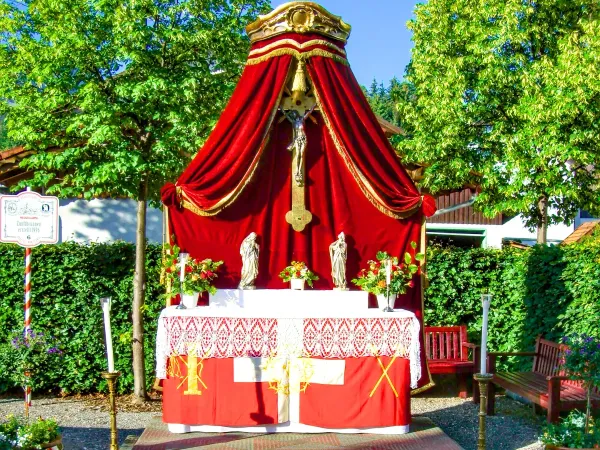
There is a festive altar, and in front of it there is a carpet made of flowers as decoration. The letters "JHS" on the carpet are the first letters of the name of Christ in Latin.

Procession during the Feast of Corpus Christi on the street: believers carry banners, you can see a canopy and a priest

Procession for the Fronleichnam holiday: people in festive clothes with ribbons and flags
Author team kalender-plus.de
Last updated: