Celebrating the Pentecost in Germany: dates, congratulations, greetings, traditions and customs
On this page, you will find information about the celebration of Pentecost in Germany, including dates by year, customs and traditions, the origins of the holiday, and popular greetings.
Dates for the Pentecost celebration in Germany
In Germany, the date of Pentecost celebration varies each year, as it is determined by the date of Easter. See calendar.
The Pentecost celebration date in Germany falls on (Sun) 24. and (Mon) 25 May 2026 this year.
Below is a list of dates for celebrating the Pentecost in Germany by year, provided that in previous and subsequent years the present practice and time of the holiday celebration is preserved:
- (Sun, Mon) 8 and 9 June 2025 - Pentecost 2025GermanyGermany
- (Sun, Mon) 24 and 25 May 2026 - Pentecost 2026GermanyGermany
- (Sun, Mon) 16 and 17 May 2027 - Pentecost 2027GermanyGermany
- (Sun, Mon) 4 and 5 June 2028 - Pentecost 2028GermanyGermany
- (Sun, Mon) 20 and 21 May 2029 - Pentecost 2029GermanyGermany
Holiday status in the territory of Germany, brief information
- Holiday name in German
- Pfingsten, Pfingstmontag
- Holiday status
- Pentecost:
The holiday is an official extra non-working day only in the state of Brandenburg. - Pentecost, 2nd day:
The holiday is an extra non-working day throughout Germany – it’s a national holiday.
- Pentecost:
- Other names of the holiday
- Trinity Sunday / Feast of the Holy Trinity / Shabuoth / Whit Sunday / Whitsun Day
- Related holidays
- Pentecost, 24 May 2026
- Pentecost, 2nd day, 25 May 2026
For more details, see the holiday description below.
How Pentecost is celebrated in Germany: customs and traditions
Pentecost is one of the most important religious holidays in Christianity; it is celebrated on the 50th day after Easter to commemorate the Holy Spirit descent on the first Christians, the event that is considered the day of the Christian congregation formation. The feast is also known as the birthday of the church. It is a public holiday in Germany, a day off from work.
The holiday embraces various customs and traditions, some of them have sunk into oblivion over time, others still exist up to date:
- Decorating the church and altar with freshly cut tree branches.
- Equestrian processions (in German: Pfingstritten) to the fields asking for the blessing of the crops.
- Cooking milk soup with almonds and eggs (in German: Pfingstmilch).
- Ring dances around the Maypole, field or church.
- Pentecost games: knightly tournaments, foot-races, shooting competitions, etc.
- Driving cattle to pastures, procession of decorated animals through populated localities.
The origin of the Pentecost
The event underlying this celebration is the Holy Spirit descent on the first Christians, which took place on the 50th day after Easter and is considered the day of the Christian congregation or church formation. The name of the holiday is associated with the 50th day on which this event took place.
Celebrating the holiday began only in the 4th century AD, hundreds of years after the event per se.
The ways pertaining to the Pentecost celebration (see above on the page) have nothing to do with Christianity and are associated with pagan superstitions and traditions of fertility and protection against evil spirits.
Photos, pictures for the holiday
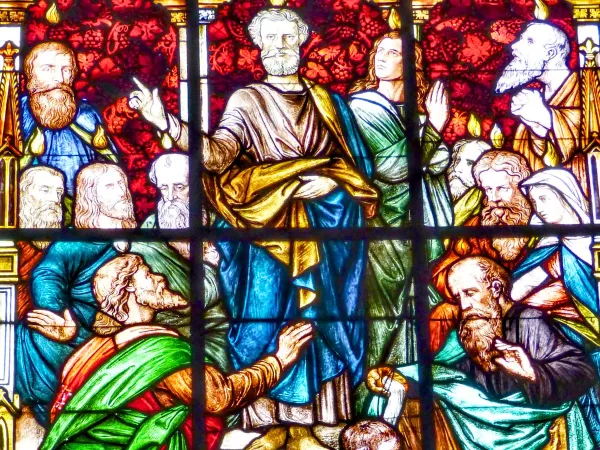
Church stained glass showing the Holy Spirit coming down as tongues of fire on the first Christians on Pentecost

Driving cattle with decorations on their horns to the fields on Pentecost day
Author team kalender-plus.de
Last updated: