Week Numbers 2026 in Germany – Current ISO Week and Full Calendar Weeks
Find the current calendar week in Germany, when it starts and ends, view all calendar weeks of 2026 and see which years have 53 weeks.
What week is it in Germany today?
Today, 16 September 2026, Germany is in ISO week 38 (KW 38). This week runs from Monday, 14/09/2026 to Sunday, 20/09/2026. Under ISO 8601, it belongs to the 2026 week-based year.
- Current week:
- KW 38
- Week-based year:
- 2026
- Start of the week:
- 14/09/2026
- End of the week:
- 20/09/2026
- Previous week:
- KW 37
- Next week:
- KW 39
- Calendar year:
- 2026
- Weeks in week-based year 2026:
- 53
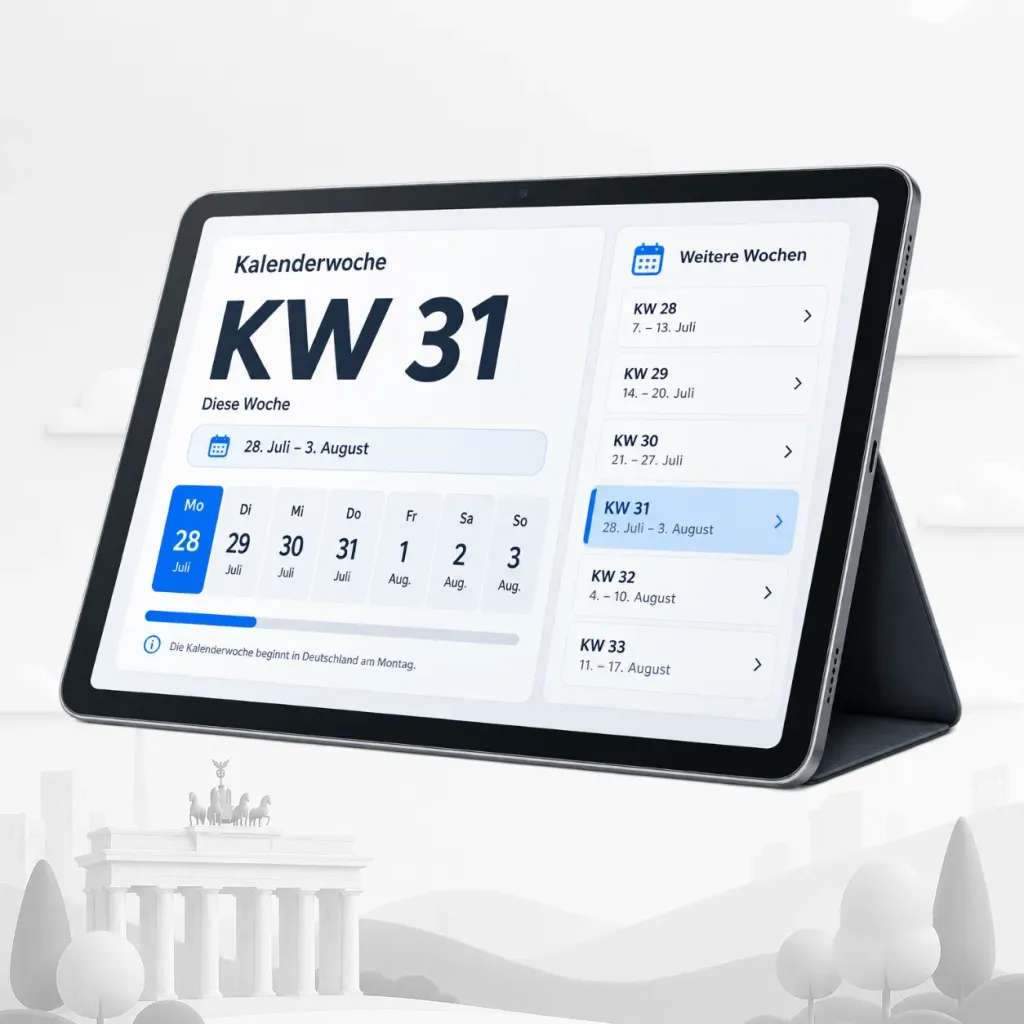
In Germany, week numbers are commonly written as KW, short for the German word Kalenderwoche. For example, ISO week 38 is usually written as KW 38 in German. Under the system used in Germany, a calendar week starts on Monday and ends on Sunday. You can find today's date, day of the week and other information on our Today in Germany page.
All calendar weeks of 2026
The table lists all 53 calendar weeks of 2026. Each week starts on Monday and ends on Sunday. The first or last calendar week may partly fall in the neighbouring calendar year.
- 2026
- 2027
ISO week numbers for 2026
| Calendar week | Start | End |
|---|---|---|
| KW 1 | ||
| KW 2 | ||
| KW 3 | ||
| KW 4 | ||
| KW 5 | ||
| KW 6 | ||
| KW 7 | ||
| KW 8 | ||
| KW 9 | ||
| KW 10 | ||
| KW 11 | ||
| KW 12 | ||
| KW 13 | ||
| KW 14 | ||
| KW 15 | ||
| KW 16 | ||
| KW 17 | ||
| KW 18 | ||
| KW 19 | ||
| KW 20 | ||
| KW 21 | ||
| KW 22 | ||
| KW 23 | ||
| KW 24 | ||
| KW 25 | ||
| KW 26 | ||
| KW 27 | ||
| KW 28 | ||
| KW 29 | ||
| KW 30 | ||
| KW 31 | ||
| KW 32 | ||
| KW 33 | ||
| KW 34 | ||
| KW 35 | ||
| KW 36 | ||
| KW 37 | ||
| KW 38 | ||
| KW 39 | ||
| KW 40 | ||
| KW 41 | ||
| KW 42 | ||
| KW 43 | ||
| KW 44 | ||
| KW 45 | ||
| KW 46 | ||
| KW 47 | ||
| KW 48 | ||
| KW 49 | ||
| KW 50 | ||
| KW 51 | ||
| KW 52 | ||
| KW 53 |
ISO week numbers for 2027
| Calendar week | Start | End |
|---|---|---|
| KW 1 | ||
| KW 2 | ||
| KW 3 | ||
| KW 4 | ||
| KW 5 | ||
| KW 6 | ||
| KW 7 | ||
| KW 8 | ||
| KW 9 | ||
| KW 10 | ||
| KW 11 | ||
| KW 12 | ||
| KW 13 | ||
| KW 14 | ||
| KW 15 | ||
| KW 16 | ||
| KW 17 | ||
| KW 18 | ||
| KW 19 | ||
| KW 20 | ||
| KW 21 | ||
| KW 22 | ||
| KW 23 | ||
| KW 24 | ||
| KW 25 | ||
| KW 26 | ||
| KW 27 | ||
| KW 28 | ||
| KW 29 | ||
| KW 30 | ||
| KW 31 | ||
| KW 32 | ||
| KW 33 | ||
| KW 34 | ||
| KW 35 | ||
| KW 36 | ||
| KW 37 | ||
| KW 38 | ||
| KW 39 | ||
| KW 40 | ||
| KW 41 | ||
| KW 42 | ||
| KW 43 | ||
| KW 44 | ||
| KW 45 | ||
| KW 46 | ||
| KW 47 | ||
| KW 48 | ||
| KW 49 | ||
| KW 50 | ||
| KW 51 | ||
| KW 52 |
A calendar year and an ISO week-based year are not the same thing. The calendar year starts on 1 January and ends on 31 December. The week-based year consists of ISO 8601 calendar weeks and begins on the Monday of week 1. As a result, the last days of December can already belong to week 1 of the following week-based year, while the first days of January can belong to week 52 or week 53 of the previous week-based year.
Week Number Calculator
Use the calculator to find the calendar week number for a date or, in the other direction, determine the start and end dates of a selected week. For example, you can enter a date to find its week number or enter KW 36/2026 to find the corresponding Monday and Sunday.
How do ISO week numbers work in Germany?
A calendar week, called Kalenderwoche in German and commonly abbreviated as KW, is a period of seven consecutive calendar days.
In Germany, calendar week numbering follows ISO 8601 and the corresponding German standard DIN ISO 8601-1. Monday is the first day of the week and Sunday is the seventh. Each calendar week therefore covers seven consecutive days from Monday to Sunday.
How are week numbers written in Germany?
In Germany, the abbreviation KW is commonly used in everyday writing. For example:
- KW 38 – week 38;
- KW 38/2026 – week 38 of 2026;
- 2026-W38 – ISO 8601 week-date notation;
- 2026-W38-3 – day 3 of week 38 in 2026, which is Wednesday.
Which week is week 1?
Week 1 is the first week containing at least four days of the new year. The same rule can be expressed another way: week 1 is the week containing the first Thursday of the year. This is why 1 January can still belong to the final week of the previous week-based year, while week 1 can begin in December.
Are calendar weeks numbered the same way worldwide?
No. ISO 8601 is widely used in Europe, but other countries and software systems may follow different rules. A week may, for example, start on Sunday, or the week containing 1 January may be treated as the first week of the year. The same date can therefore have a different week number under different systems.
Which years have 53 calendar weeks?
Most week-based years contain 52 calendar weeks, but some also have a week 53. A week-based year has 53 weeks if 1 January falls on a Thursday, or if 1 January falls on a Wednesday in a leap year.
Table of years with 53 calendar weeks
| Year | 1 January | Leap year? | Calendar weeks |
|---|---|---|---|
| 2004 | Thursday | Yes | 53 |
| 2009 | Thursday | No | 53 |
| 2015 | Thursday | No | 53 |
| 2020 | Wednesday | Yes | 53 |
| 2026 | Thursday | No | 53 |
| 2032 | Thursday | Yes | 53 |
| 2037 | Thursday | No | 53 |
| 2043 | Thursday | No | 53 |
| 2048 | Wednesday | Yes | 53 |
Having 53 calendar weeks is not directly determined by whether a year is a leap year. A common year can also have 53 calendar weeks if 1 January falls on a Thursday.
How many calendar weeks are in each year?
The following table shows the number of calendar weeks in different years. It also shows the number of days in each calendar year and whether the year is a leap year.
Number of calendar weeks by year
| Year | Calendar weeks | Days in the year | Leap year? |
|---|---|---|---|
| 2021 | 52 | 365 | No |
| 2022 | 52 | 365 | No |
| 2023 | 52 | 365 | No |
| 2024 | 52 | 366 | Yes |
| 2025 | 52 | 365 | No |
| 2026 | 53 | 365 | No |
| 2027 | 52 | 365 | No |
| 2028 | 52 | 366 | Yes |
| 2029 | 52 | 365 | No |
| 2030 | 52 | 365 | No |
| 2031 | 52 | 365 | No |
| 2032 | 53 | 366 | Yes |
| 2033 | 52 | 365 | No |
| 2034 | 52 | 365 | No |
| 2035 | 52 | 365 | No |
| 2036 | 52 | 366 | Yes |
| 2037 | 53 | 365 | No |
| 2038 | 52 | 365 | No |
| 2039 | 52 | 365 | No |
| 2040 | 52 | 366 | Yes |
| 2041 | 52 | 365 | No |
| 2042 | 52 | 365 | No |
| 2043 | 53 | 365 | No |
| 2044 | 52 | 366 | Yes |
| 2045 | 52 | 365 | No |
| 2046 | 52 | 365 | No |
| 2047 | 52 | 365 | No |
| 2048 | 53 | 366 | Yes |
| 2049 | 52 | 365 | No |
| 2050 | 52 | 365 | No |
For more about leap years, 29 February and the 4-100-400 rule, see our leap years page.
Frequently asked questions about week numbers
Questions and answers
Why does week 1 sometimes start in December?
The first calendar week is determined by the ISO 8601 rule rather than by the boundary of the calendar year. Week 1 must contain at least four days of the new year or, equivalently, the first Thursday of the year. The Monday of week 1 can therefore fall in the final days of December of the previous calendar year.
What is the difference between a calendar year and a week-based year?
The calendar year starts on 1 January and ends on 31 December. The week-based year consists of ISO calendar weeks and starts on the Monday of week 1. The last days of December can therefore already belong to week 1 of the following week-based year, while the first days of January may still belong to week 52 or week 53 of the previous week-based year.
How many calendar weeks are there in a year?
A week-based year contains 52 or 53 calendar weeks. Most years have 52 weeks, but the position of the weekdays can produce an additional week 53.
When does a year have week 53?
A year has 53 calendar weeks if 1 January falls on a Thursday. A leap year also has 53 weeks if 1 January falls on a Wednesday.
Why are there 53 weeks in 2026?
The 2026 week-based year contains 53 calendar weeks. This is because 1 January 2026 falls on a Thursday. Under ISO 8601, the week-based year therefore contains an additional calendar week 53.
Does every leap year have 53 calendar weeks?
No. A leap year contains 366 days, but that alone does not produce week 53. The position of the weekdays is what matters: in a leap year, 1 January must fall on a Wednesday or Thursday for the week-based year to have 53 weeks.
Can a non-leap year have 53 weeks?
Yes. If a non-leap year begins on a Thursday, its week-based year contains 53 weeks.
Can 1 January belong to the last week of the previous year?
Yes. If the week containing 1 January has fewer than four days in the new year, it belongs to the previous week-based year and can be week 52 or week 53.
How many days are in a calendar week?
A calendar week always contains seven days. Under ISO 8601 it begins on Monday and ends on Sunday.
What does KW mean in Germany?
KW is short for the German word Kalenderwoche, meaning calendar week. For example, KW 38 means calendar week 38 of the relevant week-based year.
Why are calendar weeks commonly used in Germany?
Week numbers are a convenient way to specify periods in business and everyday planning. They are commonly used for projects, manufacturing, construction work, logistics, deliveries and holiday planning. For example, the German phrase “Lieferung in KW 42” means that delivery is planned during calendar week 42.
How can I find the calendar week for a specific date?
Use the Calendar Week Calculator: enter a date to find its week number and week-based year. You can also perform the calculation in reverse and find the date range for a particular week number.
Notes and sources about calendar weeks
- Germany's Physikalisch-Technische Bundesanstalt (PTB) describes the ISO calendar-week rules in Zeit- und Normalfrequenzverbreitung mit DCF77: Monday is the first day of the week, and week 1 is the week containing at least four days of the new year; equivalently, it contains the first Thursday of the year.
- The current German standard DIN ISO 8601-1:2020-12 is based on ISO 8601-1:2019 and covers the standardised representation of calendar dates and times for information interchange.
- The international standard ISO 8601-1:2019 – “Date and time — Representations for information interchange — Part 1: Basic rules” – specifies rules for the standardised representation of Gregorian calendar dates and times.
- Today's date, day of the week and day number in Germany and other calendar information are available on the “Today in Germany” page.
Last updated:
Calendar week and list of all weeks in Germany