Clock Change in Germany 2026 – Summer Time and Standard Time
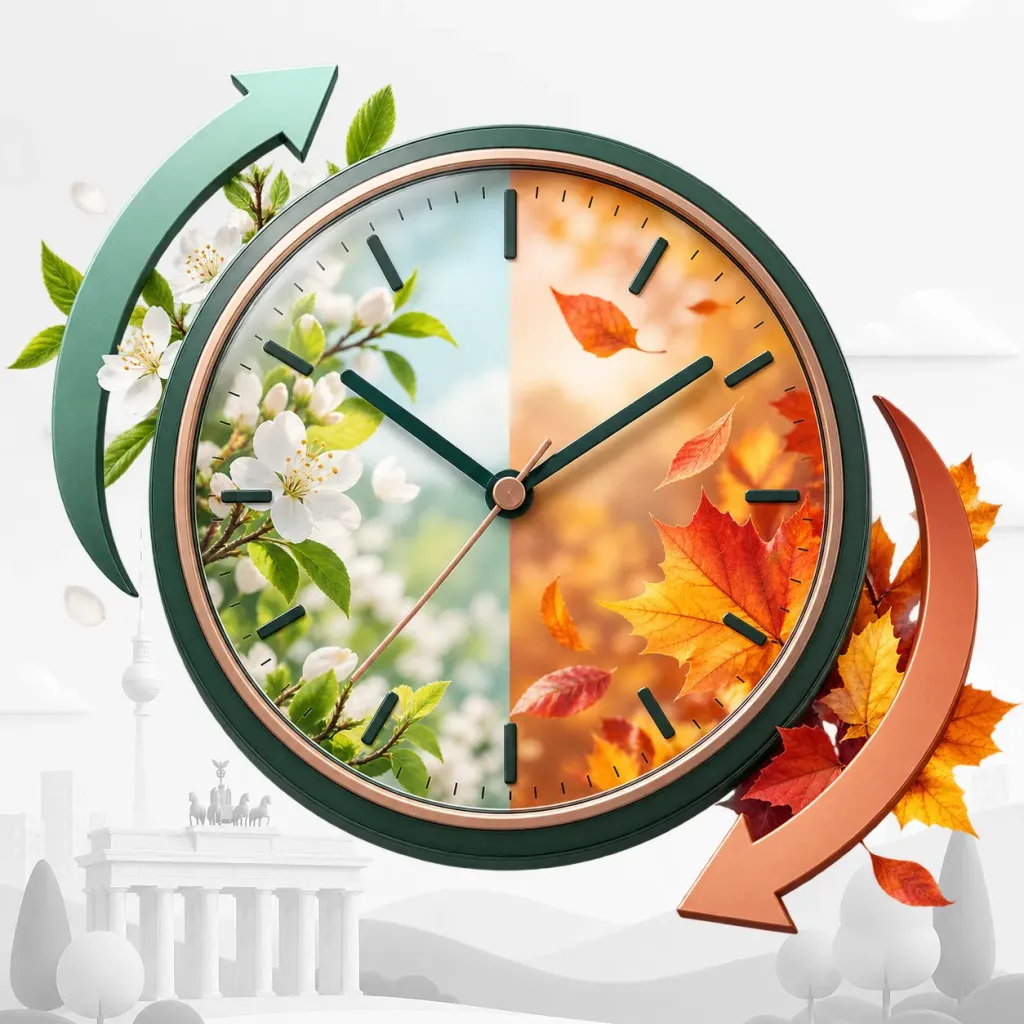
In Germany, the clocks change twice a year: they go forward by one hour on the last Sunday in March and back by one hour on the last Sunday in October. Find out when the next clock change takes place, whether Germany is currently on summer or standard time, and how the rules work.
When is the next clock change in Germany?
The next clock change in Germany is on Sunday, 25 October 2026. The clocks will change from 03:00 to 02:00 – one hour back. Germany will then use standard time CET / MEZ (UTC+01:00). There are 39 days until the next clock change.
- Date of the next clock change:
- Day:
- Sunday
- Direction:
- one hour back
- Clock change:
- 03:00 → 02:00
- Time after the change:
- CET / MEZ (UTC+01:00)
- Time remaining:
- 39 days
Germany is currently observing daylight saving time. You can check today's date in Germany and the current time in Germany on separate pages.
How can you remember whether the clocks go forward or back?
A popular German mnemonic uses garden furniture: in spring you put the furniture in front of the house (vor), and in autumn you put it back (zurück). The clocks work in the same way: forward in spring and back in autumn. In English, the familiar phrase “spring forward, fall back” expresses the same rule.

Clocks go back one hour in autumn

Clocks go forward by one hour in spring
When do the clocks change to summer and winter time in Germany?
Summer time in Germany begins on the last Sunday in March. At 02:00, the clocks move forward by one hour to 03:00. Germany returns to standard time on the last Sunday in October: at 03:00, the clocks move back by one hour to 02:00 2. Standard time is commonly referred to as winter time.
| Change | When | Clock change | New time |
|---|---|---|---|
| To summer time | Last Sunday in March | 02:00 → 03:00 | CEST / MESZ, UTC+2 |
| To standard time | Last Sunday in October | 03:00 → 02:00 | CET / MEZ, UTC+1 |
In spring, one hour is effectively skipped: after the clock reaches 02:00, the official time jumps forward to 03:00. In autumn the opposite happens: when 03:00 is reached, the clocks return to 02:00, so the hour between 02:00 and 03:00 occurs twice that night.
What is the difference between summer time and winter time in Germany?
During summer time, Germany uses Central European Summer Time (CEST), which is UTC+2. Its German name is Mitteleuropäische Sommerzeit (MESZ). This is also commonly described as daylight saving time.
After the autumn clock change, Germany returns to Central European Time (CET), which is UTC+1. Its German name is Mitteleuropäische Zeit (MEZ).
The term “winter time” is widely used in everyday language, but the more precise term is standard time. CET / MEZ is Germany's standard time, while CEST / MESZ is the summer-time adjustment used for part of the year.
Germany clock change dates by year
The following table shows the dates on which summer time begins and Germany returns to standard time. In March, the clocks move from 02:00 to 03:00; in October, they move from 03:00 back to 02:00.
| Start of summer time | Return to standard time |
|---|---|
| Sunday, 29 March 2026 | Sunday, 25 October 2026 |
| Sunday, 28 March 2027 | Sunday, 31 October 2027 |
| Sunday, 26 March 2028 | Sunday, 29 October 2028 |
| Sunday, 25 March 2029 | Sunday, 28 October 2029 |
| Sunday, 31 March 2030 | Sunday, 27 October 2030 |
| Sunday, 30 March 2031 | Sunday, 26 October 2031 |
The dates are coordinated at European Union level. The European Commission also officially publishes the dates on which the summer-time period begins and ends 3.
What laws govern the clock change in Germany?
Germany's rules on statutory time and summer time are based on German legislation together with common European Union rules.
Einheiten- und Zeitgesetz (EinhZeitG)
The basic definitions of statutory time are set out in Germany's Einheiten- und Zeitgesetz (EinhZeitG) 1. Section 4 establishes Mitteleuropäische Zeit (MEZ), or CET at UTC+1, as Germany's statutory standard time. During summer time, Mitteleuropäische Sommerzeit (MESZ), or CEST at UTC+2, applies. Section 5 allows summer time to be introduced in order to make better use of daylight and to align Germany's timekeeping with neighbouring countries, and provides the legal basis for defining when summer time begins and ends.
Sommerzeitverordnung (SoZV)
The specific clock-change rules are laid down in the Sommerzeitverordnung (SoZV) 2. Under section 2, summer time begins on the last Sunday in March at 02:00 MEZ, when the clocks move from 02:00 to 03:00. It ends on the last Sunday in October at 03:00 MESZ, when the clocks move back from 03:00 to 02:00.
During the autumn clock change, the period between 02:00 and 03:00 occurs twice. The German Sommerzeitverordnung even provides special designations for the two periods: the first 02:00–03:00 hour under summer time is designated 2A, while the repeated hour after the change to standard time is designated 2B.
European Union rules
Seasonal clock changes are also coordinated at European Union level. Directive 2000/84/EC establishes common start and end dates for the summer-time period in EU Member States, so participating countries change their clocks on a coordinated basis.
Frequently asked questions about clock changes in Germany
Questions and answers
Do the clocks go forward or back in spring?
In spring, the clocks go forward by one hour, from 02:00 to 03:00. This marks the beginning of CEST / MESZ summer time.
Do the clocks go forward or back in autumn?
In autumn, the clocks go back by one hour, from 03:00 to 02:00. Germany returns to CET / MEZ.
Are winter time and standard time the same thing?
Yes. CET / MEZ is commonly called winter time in everyday language. The more precise term is standard time. CEST / MESZ is the seasonal summer-time adjustment one hour ahead.
Do all German states change their clocks at the same time?
Yes. All 16 German federal states change their clocks at exactly the same time. There are no regional differences in the clock-change rules within Germany.
Why does Germany change the clocks?
German legislation lists better use of daylight and alignment of timekeeping with neighbouring countries among the purposes of summer time.
Does changing the clocks save energy?
No significant energy-saving effect has been established 4. Reduced need for lighting in the evening may be partly offset by additional energy use in the morning, for example for lighting and heating.
Do I need to change the time manually on my smartphone?
Usually not. If automatic date and time and automatic time-zone settings are enabled, modern smartphones and computers normally make the change automatically. Clocks without automatic synchronisation need to be adjusted manually.
Do we gain an extra hour in autumn?
When the clocks move back from 03:00 to 02:00, the period between 02:00 and 03:00 occurs twice. That calendar day is therefore one hour longer.
Do we lose an hour in spring?
Yes, in terms of the length of that calendar day. When the clock jumps from 02:00 to 03:00, one hour is skipped, so the day on which summer time begins is one hour shorter than usual.
Can the time difference between Germany and other countries change?
Yes. If another country does not change its clocks, or makes the change on different dates, the time difference with Germany may vary by one hour during the year.
Has Germany abolished the clock change?
No. As of 2026, no final EU decision to abolish seasonal clock changes has taken effect. Germany therefore continues to follow the current rules.
Since when has Germany used the modern seasonal clock change?
The modern uninterrupted use of summer time in the Federal Republic of Germany dates from 1980 5. Historically, summer time was first introduced in Germany in 1916.
Notes and sources for clock changes in Germany
- Germany's statutory time is defined in section 4 of the Einheiten- und Zeitgesetz (EinhZeitG): MEZ / CET is UTC+1, while MESZ / CEST is UTC+2 during summer time.
- Section 2 of the Sommerzeitverordnung (SoZV) states that summer time begins on the last Sunday in March with the change from 02:00 to 03:00 and ends on the last Sunday in October with the change from 03:00 back to 02:00.
- The European Commission officially publishes the dates on which the summer-time period begins and ends. For 2026 these are 29 March and 25 October. For 2027–2031 the published dates are: 28.03/31.10.2027, 26.03/29.10.2028, 25.03/28.10.2029, 31.03/27.10.2030 and 30.03/26.10.2031.
- According to Germany's Umweltbundesamt, seasonal clock changes are not an effective measure for achieving substantial energy savings: lower energy use in some areas can be offset by higher consumption in others.
- According to the Physikalisch-Technische Bundesanstalt (PTB), summer time was first used in Germany in 1916. After several historical periods, the modern uninterrupted use of summer time in the Federal Republic of Germany began in 1980.
- For the current time and time zone, see our page Current Time in Germany.
Last updated:
Changing the Clocks in Germany — Summer Time and Winter Time