Current Time in Germany – Live Clock, CET/CEST and Time Zone
Live online clock with seconds for Germany. Find Germany's current time and time zone, and learn how official German time is determined and distributed.
Wednesday, 16 September 2026 ↻
What time is it in Germany now?
It is currently ↻ in Germany. Germany is on Central European Summer Time (CEST, UTC+2) and uses the IANA time zone Europe/Berlin. Germany has one time zone, so the same local time applies throughout the country.
- Date:
- Day of the week:
- Wednesday
- Time zone:
- Europe/Berlin (CEST)
- UTC offset:
- +02:00
- Last time change:
- Sunday, 29 March 2026
one hour forward - Next time change:
- Sunday, 25 October 2026
one hour back
Berlin, Hamburg, Munich, Cologne, Frankfurt am Main, Dresden and every other city in Germany use the same official local time. There is therefore no time difference between cities within Germany.
| City | Current time |
|---|---|
| Berlin | |
| Hamburg | |
| Munich | |
| Cologne | |
| Frankfurt am Main |
For today's date, day of the week, current week number and other calendar information for Germany, see our Today in Germany page.
What time zone is Germany in?
Germany uses Central European Time. During standard time it is CET (UTC+1), while during summer time(Daylight Saving Time, DST) it is CEST (UTC+2). Germany's IANA time zone identifier is Europe/Berlin. It currently observes CEST.
For dates and rules, see our guide to clock changes and summer time in Germany.
In German, Central European Time is abbreviated as MEZ (Mitteleuropäische Zeit), while Central European Summer Time is MESZ (Mitteleuropäische Sommerzeit). The internationally used abbreviations are CET and CEST.
| Abbreviation | Meaning | UTC offset |
|---|---|---|
| MEZ | Mitteleuropäische Zeit | UTC+1 |
| CET | Central European Time | UTC+1 |
| MESZ | Mitteleuropäische Sommerzeit | UTC+2 |
| CEST | Central European Summer Time | UTC+2 |
| UTC | Coordinated Universal Time | UTC±0 |
MEZ and CET therefore refer to the same UTC+1 time, while MESZ and CEST both refer to UTC+2.
What is Germany's legal time?
Germany's legal time (gesetzliche Zeit) is defined by the Law on Units and Time (Einheiten- und Zeitgesetz, EinhZeitG). Under section 4 of the Act, Central European Time (MEZ/CET) is the statutory standard time and is defined as Coordinated Universal Time plus one hour. During summer time, Central European Summer Time (MESZ/CEST), UTC plus two hours, becomes the legal time.
The Physikalisch-Technische Bundesanstalt (PTB), Germany's national metrology institute, is responsible for representing and distributing the country's legal time. This responsibility is set out in section 6 of the EinhZeitG. The legal provisions can be found in the Einheiten- und Zeitgesetz (EinhZeitG) and the rules for summer time in the Sommerzeitverordnung (SoZV).
How is the precise time in Germany determined?
Germany's precise timekeeping is based on the national time scale UTC(PTB), which is realised by the Physikalisch-Technische Bundesanstalt using high-precision atomic clocks. UTC(PTB) is kept as closely aligned as possible with international UTC and provides the basis for Germany's legal time: UTC+1 for CET/MEZ and UTC+2 for CEST/MESZ.
Coordinated Universal Time (UTC) is realised through cooperation between national metrology institutes in many countries. Germany's precise time is therefore part of an international timekeeping system rather than an independent national clock operating in isolation.
The PTB distributes time through NTP/NTS time servers on the internet and through the DCF77 radio time signal. Computers, servers, radio-controlled clocks and other devices can use these services to synchronise their own clocks.
Which official time servers does Germany use?
For technical clock synchronisation, the Physikalisch-Technische Bundesanstalt (PTB) provides public time servers. They use the Network Time Protocol (NTP). The PTB servers also support Network Time Security (NTS), which provides authenticated and cryptographically protected time synchronisation.
Official PTB time servers in Germany
| No. | PTB time server |
|---|---|
| 1. | ptbtime1.ptb.de |
| 2. | ptbtime2.ptb.de |
| 3. | ptbtime3.ptb.de |
| 4. | ptbtime4.ptb.de |
These addresses are time synchronisation servers, not ordinary websites. They can be configured in an operating system, NTP client, server or other equipment that needs a reliable time source. The device contacts a time server periodically, compares the returned time with its own system clock and adjusts it when necessary.
How do radio-controlled clocks receive the exact time in Germany?
Many radio-controlled clocks in Germany receive their time from the DCF77 long-wave transmitter. It is located at Mainflingen (50°01′ N, 9°00′ E), near Frankfurt am Main, and broadcasts time signals on 77.5 kHz.
DCF77 transmits a time code containing the minute, hour, calendar date, day of the week, month and year, together with information needed to display the time currently in force in Germany. The DCF77 signal can be received across a large part of Europe. The PTB describes an area of roughly 2,000 km around the transmitter at Mainflingen in which continuous reception is generally possible, although actual reception depends on distance and local conditions. This allows many household radio-controlled clocks to set their date and time automatically and to follow the change between standard time and summer time.
Frequently asked questions about the time in Germany
Questions and answers
How accurate is the online clock?
The online clock displays the time to the nearest second, but the value shown in your browser is not a direct display from a PTB atomic clock. The actual difference from UTC(PTB) can be affected by network latency, browser behaviour and the device being used.
Why does my computer or phone show a different time?
A difference may occur if automatic time synchronisation is disabled, the wrong time zone is selected, the device's system clock has drifted, or it has not synchronised with a time server for some time. Small differences can also result from network and browser delays.
Is the time the same in every city in Germany?
Yes. The same official local time applies throughout Germany. Berlin, Hamburg, Munich, Cologne, Frankfurt am Main and all other German cities therefore have the same local time. There is no time difference within Germany.
When does a new day begin in Germany?
A new calendar day in Germany begins at 00:00 according to the official local time currently in force. Standard time is CET/MEZ (UTC+1) and summer time is CEST/MESZ (UTC+2). At midnight the date, day of the week and day number of the year change.
Who is responsible for the official time in Germany?
The Physikalisch-Technische Bundesanstalt (PTB) is responsible for realise and disseminate Germany's legal time. It maintains the national time scale UTC(PTB), using atomic clocks.
What is Germany's legal time?
Under the Einheiten- und Zeitgesetz, Germany's statutory standard time is Central European Time, MEZ/CET (UTC+1). During summer time it is MESZ/CEST (UTC+2).
Where can the exact German time be checked?
For technical synchronisation, the PTB provides ptbtime1.ptb.de, ptbtime2.ptb.de, ptbtime3.ptb.de and ptbtime4.ptb.de. These are NTP/NTS servers rather than normal web pages.
What is an NTP time server?
An NTP time server supplies computers and other networked devices with time information so that their system clocks can be synchronised with a reliable source. NTP stands for Network Time Protocol.
What is DCF77?
DCF77 is Germany's long-wave radio time transmitter at Mainflingen, near Frankfurt am Main. It operates at 77.5 kHz and is used, among other things, to synchronise radio-controlled clocks automatically.
What is the difference between CET and CEST?
CET is Central European standard time at UTC+1. CEST is Central European Summer Time at UTC+2. Their German abbreviations are MEZ and MESZ respectively.
What time does the date change in Germany?
The date changes at 00:00 according to Germany's official local time. This is when the new calendar day begins.
Does Germany change its clocks?
Yes. When summer time begins, clocks move forward from 02:00 to 03:00. When standard time returns, clocks move back from 03:00 to 02:00.
Notes and sources for time information in Germany
- Online clock: When this page is opened, the Kalender Plus server requests the current time from the PTB time server
ptbtime1.ptb.deoperated by the Physikalisch-Technische Bundesanstalt (PTB) and obtains the current time to the nearest second. The calculation takes account of the time required to receive the server response before the resulting value is sent to the browser. JavaScript then advances the clock locally, second by second. If the page remains open for a long period, a small drift can gradually develop because of the browser or device. Clicking the refresh button ↻ next to the clock triggers a new server request and synchronises the displayed time again. - Germany's legal time is defined in section 4 of the German Units and Time Act (EinhZeitG).
- The Physikalisch-Technische Bundesanstalt (PTB) provides the public time servers
ptbtime1.ptb.de,ptbtime2.ptb.de,ptbtime3.ptb.deandptbtime4.ptb.defor time synchronisation. Both NTP and the secured NTS protocol are supported. - The DCF77 long-wave transmitter is located at Mainflingen near Frankfurt am Main and operates at 77.5 kHz. Its signal is used to distribute official time and, among other applications, to synchronise radio-controlled clocks automatically.
Last updated:
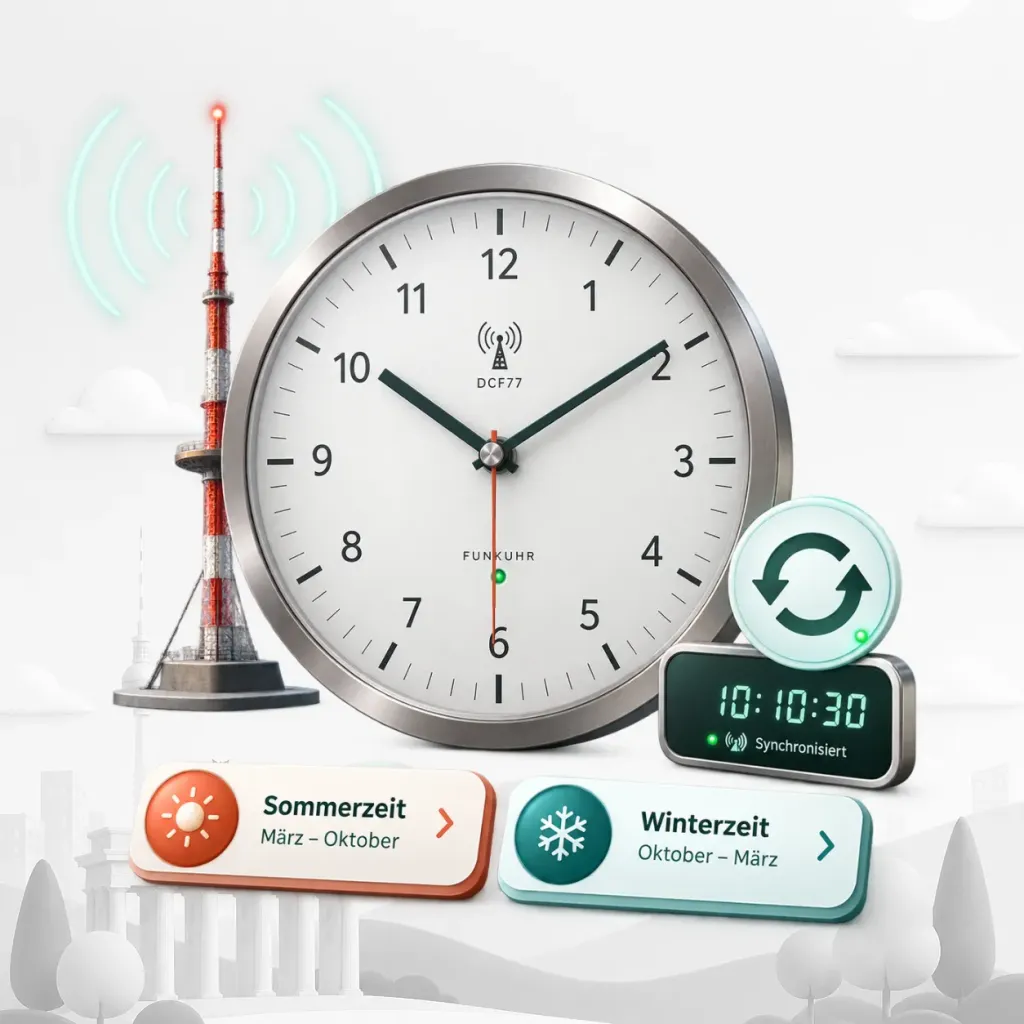
Online clock with seconds in Germany