Celebrating the Labour Day and May holiday in Germany: dates, congratulations, greetings, traditions and customs
On this page, you will find information about the celebration of May Day in Germany, including dates by year, customs and traditions, the origins of the holiday, and popular greetings.
Dates for the May Day celebration in Germany
The date of the Labour Day celebration in Germany remains unchanged every year and falls on 1 May. See calendar.
The Labour Day celebration date in Germany falls on Friday, 1 May 2026 this year.
Below is a list of dates for celebrating the May Day in Germany by year, provided that in previous and subsequent years the present practice and time of the holiday celebration is preserved:
- (Thu) 1 May 2025 - May Day 2025GermanyGermany
- (Fri) 1 May 2026 - May Day 2026GermanyGermany
- (Sat) 1 May 2027 - May Day 2027GermanyGermany
- (Mon) 1 May 2028 - May Day 2028GermanyGermany
- (Tue) 1 May 2029 - May Day 2029GermanyGermany
Holiday status in the territory of Germany, brief information
- Holiday name in German
- 1. Mai
- Holiday status
- The holiday is an extra non-working day throughout Germany – it’s a national holiday.
- Other names of the holiday
- May Day / May 1
- Related holidays
- May Day, 1 May 2026
- May Day, 1 May 2026
For more details, see the holiday description below.
Wishes and congratulations, greetings on the May Day in Germany
For congratulations on May 1, postcards are sold in Germany. Typical wishes for May 1:
- Schönen 1. Mai (Happy May 1st )
- Ich wünsche Euch einen wunderschönen Maifeiertag! (I wish you a wonderful May holiday)
- Schönen Maifeiertag (Happy May Day)
- Herzliche Grüße zum Maifeiertag (Warm greetings on May Day)
How May Day is celebrated in Germany: customs and traditions
May 1st in Germany is not only the International Labour Day, it is also a traditional German May holiday. Thus, in Germany, on May 1 two holidays fall at a time, although people do not attach much importance to these two events, but, like on many other holidays, they just do as is customary.
May Day in Germany
Immediately after the Walpurgis Night there comes the May Day holiday, the customs and traditions of which are associated with ancient fertility rituals (for more details regarding the origin of the holiday, see below on the page). On this day, a maypole or a May Tree (in German: Maibaum) is set up in the centre of a locality, be it a city or a village, - it is a birch or spruce cleared of bark and branches topped with a May crown, with the trunk furnished with platforms having wooden figurines placed on them here and there. Such trees can be 20-30 meters high. And the competitors are to climb the maypole.
Merry dances with ribbons tied to the maypole are given around the May Tree. Traditionally, the May Queen is chosen on this day. Different parts of Germany have other traditions that are followed on this day, for example: processions through the fields, May fish, May drink, May beer, festivities in tents or in certain streets, and many more.
Besides, on the occasion of May 1, there are discos, concerts held under the slogan "Tanz in den Mai" (dance into May), where it is also customary to wear masks or fancy-dresses. These dances take place on the night of May 1 or the Walpurgis Night.
International Labour Day in Germany
Labour Day in Germany is an official public holiday and a day off from work. For the vast majority of people, this is just a day off, dedicated to family and leisure, with no political significance.
However, political organizations, parties from time to time organize various events on this day, such as rallies or protests. Besides, this day may witness violent clashes and protests taking place in major cities of Germany.
The holidays celebrated in Germany on May 1 have totally different origins; below you will find both holidays origins description.
The origin of the May Day
May Day holiday in Germany
Traditions and customs of the May Day holiday in Germany date back to ancient Rome, where the goddess of the earth and fertility called Maia was revered, from whom the month of May derives its name. The feast of this goddess was celebrated on May 1, on this day people organized festivities with dances and games, as well as chose the May Queen. The celebration was accompanied by processions through fields and populated localities and May greetings. The maypole, originally a birch, considered a holy tree because of its trunk colour, symbolized the goddess of fertility.
International Labour Day in Germany
The International Labour Day celebration has a common origin for all countries; it originated in the United States of America of the 19th century. Back in the 19th century, working people did not have any special rights, they worked for extremely low wages, for 10 or more hours a day, did not have the vacation privilege, and children also had to go to work. In order to eliminate this unfair situation, protests began in the United States, the first of which took place on May 1, 1886.
Later, the Congress of Paris declared May 1, 1890, the International Workers Day, which day was accompanied by demonstrations and demands put forward by the workers. Over time, this holiday has become annual and worldwide.
Photos, pictures for the holiday

Setting up a Maypole in the city square
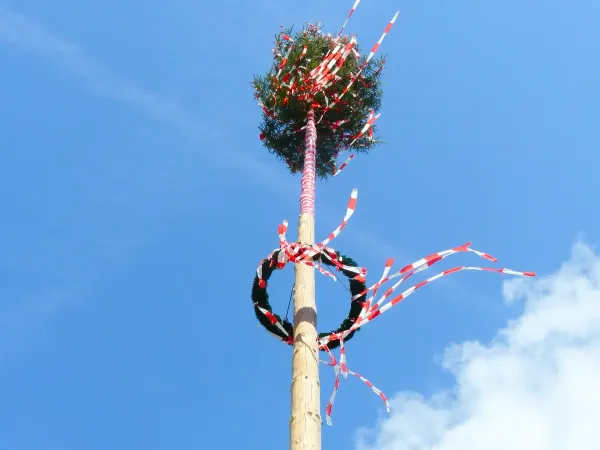
May tree (Maibaum)
Author team kalender-plus.de
Last updated: